Quick answer: the AUXITO T4 is the pick for most everyday drivers
For most gas sedans and SUVs, buy the AUXITO T4 8000A (US$99.99 as of 2026-09-12). It cranks gas and diesel engines, doubles as a USB power bank, and fits in a glove box. Spend less with the AUXITO T3 6000A (US$79.99) if you drive a small gas car, or step up to the AUXITO T5 9500A (US$159.99) for big diesels and cold-climate margin.
If you also want a tire inflator in the same box, the WOLFBOX MegaVolt16 Air (US$179.40) is the 4-in-1 that replaces two trunk gadgets with one.
Best portable jump starters at a glance
| Pick | Key spec | Best for | Price | Seller |
|---|---|---|---|---|
| 1 AUXITO T4 8000A | 8000A peak, 12V, gas and diesel engines, USB power bank | Most everyday sedans, SUVs and light trucks | US$99.99 as of 2026-09-12 | Check seller page |
| 2 AUXITO T3 6000A | 6000A peak, 12V, all gas engines and diesel up to 12L | Budget buyers with small and mid-size gas cars | US$79.99 as of 2026-09-12 | Check seller page |
| 3 AUXITO T5 9500A | 9500A peak, 12V, all gas and all diesel engines, USB-C fast charge | Large diesels, cold winters, and power-bank duty | US$159.99 as of 2026-09-12 | Check seller page |
| 4 WOLFBOX MegaVolt24 4000A | 4000A peak, 65W quick charger, compact pack | Drivers who want fast recharge and a slim pack | US$173.00 as of 2026-05-10 | Check seller page |
| 5 WOLFBOX MegaVolt16 Air 4-in-1 | 3000A peak jump starter plus tire air compressor, flashlight, power bank | One box for jump starts and low tires | US$179.40 as of 2026-09-12 | Check seller page |
Prices are seller listings as of 2026-09-12 and can change. Confirm on the seller page before you buy.
Reviewer favourites you will see elsewhere (the NOCO Boost Plus GB40, the Weego 22s, and the Clore Jump-N-Carry JNC325) are solid packs too, but we do not track seller links for them yet, so the table above sticks to products you can check and buy today.
Who this is for (and who should look elsewhere)
This guide is for everyday gas or diesel drivers. You want a dependable tool to keep in your trunk or glove box, not a heavy-duty unit for a professional mechanic’s shop. Read through and you’ll know exactly which jump starter is right for your vehicle and which ones to skip.
It is a great fit if you drive ordinary vehicles. You should match the pack to your engine size. For example, a 3000A pack can usually handle gas engines up to 8L or diesel engines up to 6L. A smaller 1000A pack might handle gas engines up to 6L or diesel engines up to 3L.
If you own a hybrid or an electric vehicle (EV), you are not the primary audience for these tools. While you might need to jump a 12V auxiliary battery through a specific terminal, these packs are not designed to jump the high-voltage main battery.
If you manage a fleet of vehicles or heavy-duty trucks with massive engines, you might want a premium 4250A powerhouse. But for a typical sedan or small SUV, that is usually overkill. Most drivers prefer compact packs that can be tucked behind a seat or inside a glove box.
How to choose: the four specs that actually matter
Peak amps get all the attention in advertisements, but these four factors actually determine if the pack will work for you.
- Cranking amps vs. engine size: You must match the rated output to your engine’s displacement. Think of it like a heavy door; a small person can push a light door, but a heavy industrial door needs more force. A 1000A pack is fine for a small gas engine, but a large diesel engine will need more power.
- Operating temperature range: Some packs say they work from -20°C to 60°C. However, a pack left in freezing weather might struggle to engage.
- Form factor: This is the physical size. You can find a 3000A unit that includes an air compressor and still fits in a glove box, but very high-capacity packs will be heavier and harder to store.
- Clamp quality and indicators: Good clamps make a huge difference. The Weego 22s is praised for its design, and some packs provide a green light to confirm you have a correct connection before you try to crank the engine.
Product groups: compact daily carry vs. high-power reserve vs. multi-function
The market generally falls into three categories.
Compact daily carry These are small, reliable, and easy to store. The NOCO Boost Plus GB40 and Weego 22s fall into this group. They are the top picks for people who want a simple tool that just works when needed.
High-power reserve These are for larger vehicles or more extreme needs. The Gooloo GT6000 and AUXITO T5 offer massive peak currents (6000A to 9500A). The GT6000 can jump everything from a motorcycle to a 12L diesel engine.
Multi-function These do more than just jump a car. The WOLFBOX MegaVolt16 Air provides a 3000A jump start and includes a tire air compressor. The AUXITO T5 adds triple USB ports, including USB-C, so it can act as an emergency power bank.
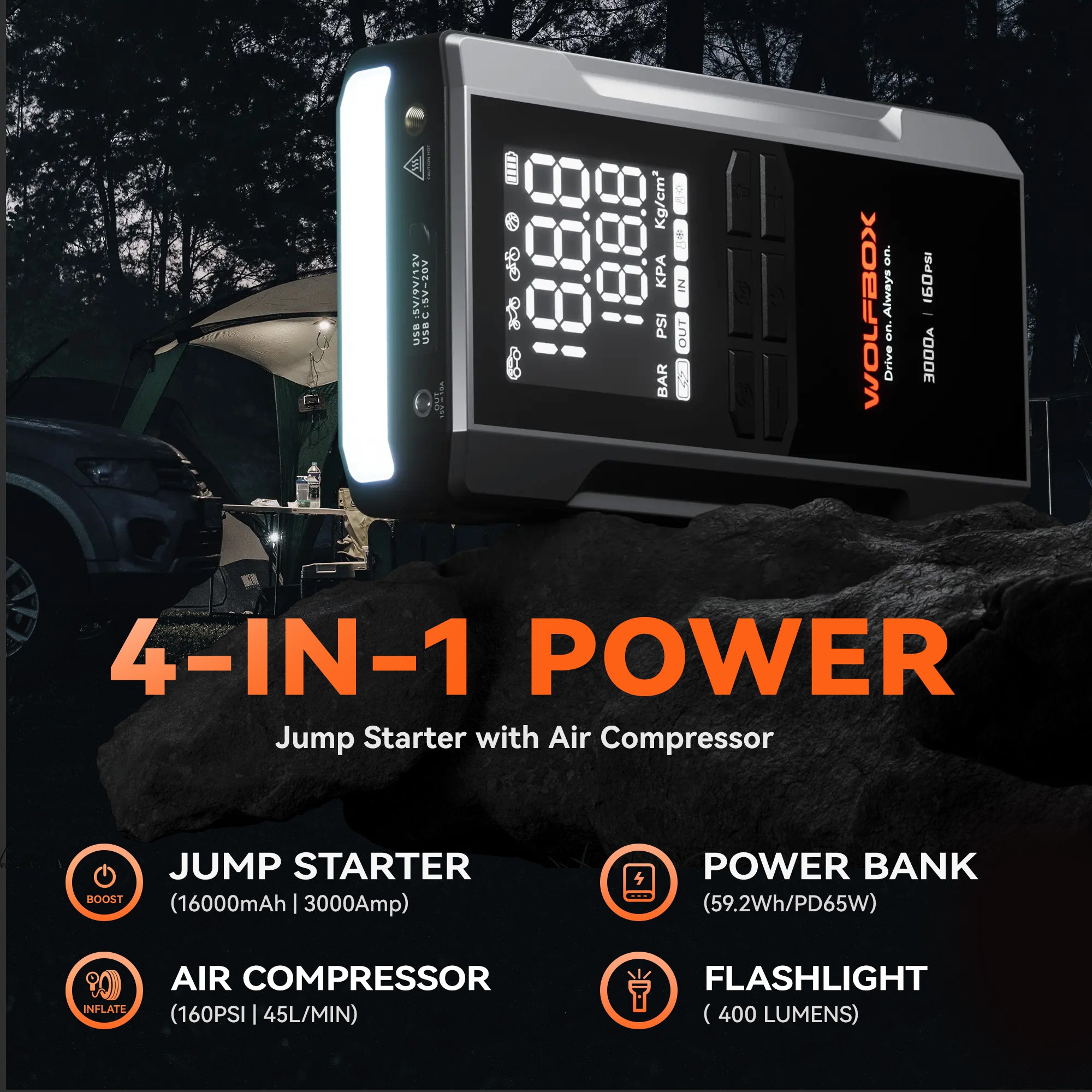
WOLFBOX MegaVolt16 Air Portable 4-in-1 Jump Starter with Air Compressor
gearnudge.com
- Best for
- A 3000A jump starter and air compressor in one.
- Avoid if
- You need confirmed live price or guaranteed fit from this page.
- Evidence
- Listing and source evidence
The trade-off Multi-function and high-power packs offer more utility, but they also bring more weight and more things to maintain. Conventional compact packs focus on doing one job very well.
Note that the Clore Jump-N-Carry JNC325 sits slightly outside these tiers. It earned “Best Overall” praise for its ease of use and long 24-inch cables rather than fitting a specific “compact” or “multi-function” niche.
Compatibility & safety checks before you buy
Before you buy, double-check these limits so you don’t end up stuck in your driveway.
- Confirm the engine size: Check the manual. The NOCO GB40 is for gas engines up to 6 liters and diesel up to 3 liters. The WOLFBOX 3000A unit claims it can handle up to 8L gas or 6L diesel.
- Hybrid rules: If you have a hybrid, you only jump the 12V auxiliary battery. Use the designated jump terminal and never use a hybrid as the “donor” car to jump someone else.
- 12V only: These are 12V tools. They are not suitable for electric vehicles with built-in rechargeable high-voltage batteries.
- Check the charge: Never attempt to use a jump starter if it has less than 30% power remaining.
Setup & use: the correct connection sequence and why it matters
The order in which you connect the clamps is about safety, not just following a manual.
- Connect the red positive clamp to the positive battery post on the dead battery first.
- Connect the black negative clamp to a bare metal chassis ground. Do not connect it to the negative battery terminal.
Grounding to a metal part of the engine or frame instead of the battery terminal is vital. A small spark can occur the moment you make a connection. If that spark happens right at the battery, it could ignite escaping gases. Using a metal ground point reduces this explosion risk.
Some packs, like the NOCO GB40, include spark-proof technology and reverse-polarity protection. Even so, you should always follow the correct sequence. Look for feedback: a green light usually means the connection is correct, while a red light means the poles are reversed.
Storage habits that kill packs (and how to avoid them)
It is rarely the electronics that fail; it is usually how the pack is stored.
Cold and Heat Cold is a major enemy. A NOCO GB40 left in a truck at 10°F once refused to engage at all. Similarly, high heat can damage the lithium cells. Owners have reported swollen units after being left in extreme heat, and most guides suggest avoiding temperatures above 140°F.
Self-discharge Lithium packs lose power even when you aren’t using them. If you let a pack drain completely, it might become a “paperweight” that refuses to recharge.
Best practices for storage:
- Store the pack in a temperature-controlled environment (ideally between 50°F and 80°F).
- Keep the charge between 50% and 80%.
- Recharge the pack every 3 to 6 months to prevent it from draining too low.
Avoid-if guidance: when to skip a portable jump starter
A portable jump starter is not the right tool for every situation.
- Skip for hybrids/EVs unless you are very confident about using the specific 12V auxiliary jump terminal and understand high-voltage safety.
- Skip for damaged or frozen batteries. Official manuals state you should never use a jump starter on a battery that is physically damaged or frozen.
- Don’t buy based on peak-amp marketing alone. Some budget units claim 4000A or 8000A but actually deliver a much smaller fraction of that power during real-world tests.
- Skip for extreme climate storage. If you plan to leave the pack in your car year-round in a place with freezing winters or scorching summers, it may not be dependable.
FAQ
How often should I charge it?
Recharge it monthly if you use it regularly. For long-term storage, aim for every 3 to 6 months. Always try to keep the charge between 50% and 80%.
Can I use it as a USB power bank?
Yes. Many models offer this. The AUXITO T4 has a 5V/2.4A USB output, and the AUXITO T5 includes fast-charging USB-C ports.
Are the cables long enough?
It depends on the model. The Clore JNC325 uses 24-inch cables, which reviewers found very easy to use.
Can a pack do more than just crank the engine?
Yes. A 6000A unit was once tested starting a completely dead battery and then actually running the car for 30 seconds using only about 1% of its charge.
What should I read before trusting it?
Always read the official manual. It contains critical rules, such as not using the tool on frozen batteries, not using it on EVs, and ensuring the pack has more than 30% power before use.