Quick answer: the safe-loading rule
One driver ripped their crossbars clean off the roof while off-roading because they ignored the weight limit. Here’s the safe-loading rule in five points:
- Respect the weight limit: Add the weight of the empty rack/box to the weight of your gear. This total must be lower than both your vehicle’s roof limit and the rack’s maximum capacity.
- Keep heavy stuff low: Put heavy items in the cabin or the trunk. Only light, bulky items like sleeping bags or jackets should go on the roof.
- Use real straps: Use proper tie-down straps. Avoid elastic bungee cords or ropes, as they don’t stop gear from sliding off.
- Check your work: Tighten everything before you leave, check again after a short drive, and re-check at every rest stop.
- Drive differently: Roof cargo makes your car taller and more sensitive to wind. Slow down and watch out for crosswinds.
Who this is for
Roof boxes and specialized racks are great if you need to carry bulky, lightweight items. They are perfect for things like skis, luggage, or camping gear during a long road trip or an overlanding adventure.
However, they are not meant for heavy loads. If an item is heavy, it belongs in the cabin or the cargo area. Keeping heavy weight low helps your car handle better and keeps your center of gravity stable.
Know your limits first
Before you strap anything down, you need to know your numbers. Your vehicle’s roof load limit isn’t just about the stuff you pack; it includes the weight of the rack system, the mounting bars, and the cargo itself.
Your safe limit is whichever number is lower: your vehicle’s rating or your rack’s rating. If you ignore these limits, you can cause serious damage. One off-road driver even reported ripping their crossbars straight out of the roof because they exceeded the capacity.
To protect your car’s handling, always keep the load distributed evenly and as low as possible.
Roof box options: tested picks and price range
Reviewers who test roof boxes year after year rate the INNO Wedge 660 (list $850) the best overall. Testers liked the tool-free install and the dual-side opening, though it can’t fit bulky items. Yakima is the other brand that keeps winning recommendations. The Yakima Skybox Carbonite ($550-820) is GearJunkie’s go-to with a 165 lb capacity, and Wirecutter and Travel + Leisure also picked the Yakima SkyBox (NX) line. If you want maximum space, Travel + Leisure’s best overall after testing 31 carriers over 3 years is the Thule Motion 3 Large ($1,100) — 16 cubic feet of space and a 165 lb capacity, which is the standard roof-box ceiling. A box isn’t the only way to haul gear. If most of your loads are bulky and awkward, a roof cargo platform is worth a look.
Prices in this guide are vendor listings as of 2026-08-11 and can change, so confirm the current price on the seller page before you buy.
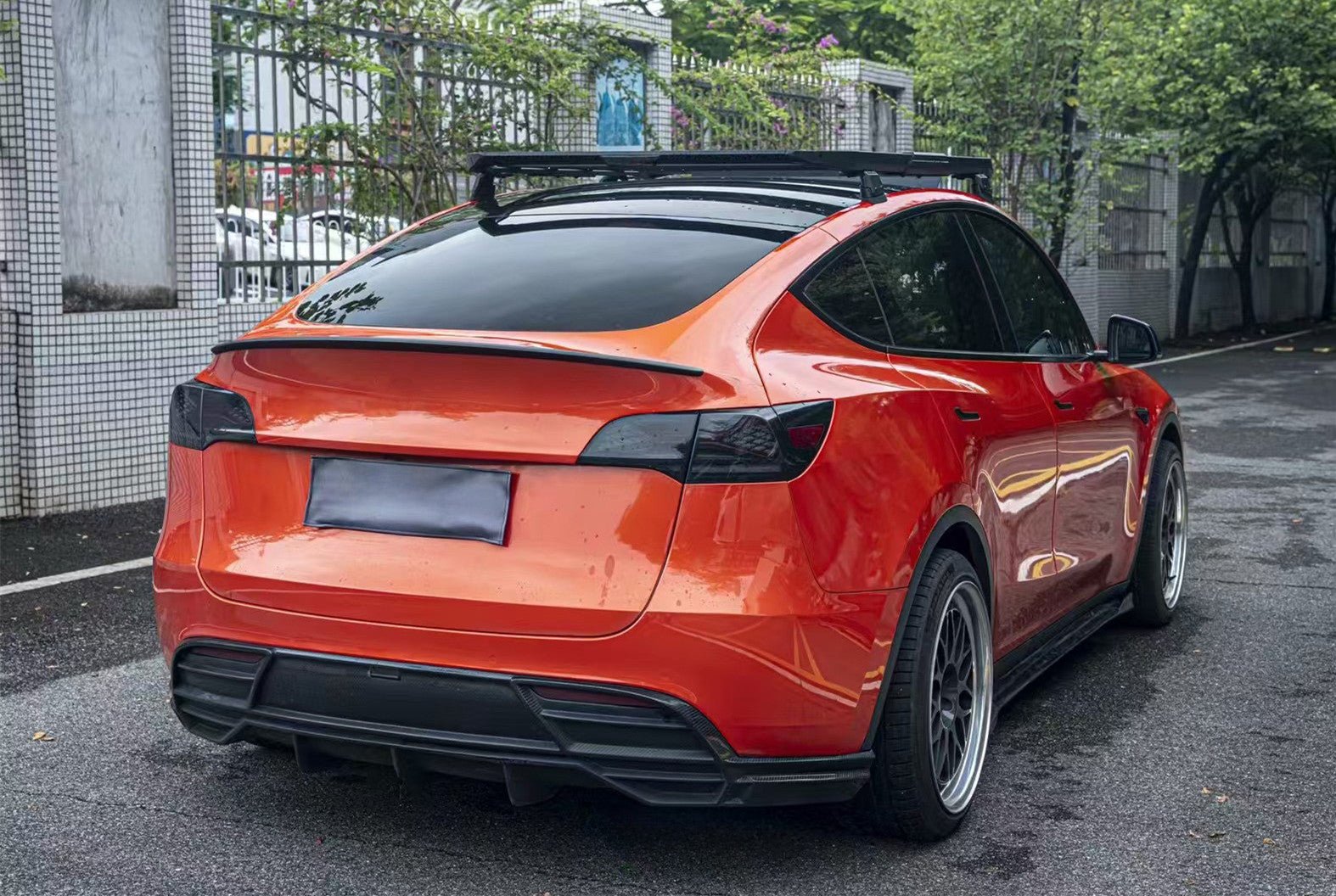
TESERY Roof Rack Cargo Platform for Tesla Model Y & Model Y Juniper
gearnudge.com
- Best for
- A cargo platform keeps bulky gear on the roof when a box won't fit
- Avoid if
- You need confirmed live price or guaranteed fit from this page.
- Evidence
- Listing and source evidence
Before you buy, remember the safe-loading rule: whatever carrier you pick, the combined weight of the rack, the carrier, and the gear has to stay under the lower of your vehicle’s roof rating or the carrier’s own limit.
Tie-down options: straps and price range
Never rely on rope or elastic straps to hold down heavy gear. You need proper tie-down straps with specific “working load” ratings. The working load is the amount of weight the strap can safely handle during use.
- Budget options: A 4-pack of Husky straps costs around $22 and offers a 500-lb working load.
- Mid-range options: A Rhino Rack HD set is roughly $30 and can handle a massive 1,736-lb working load.
- Premium options: Mac’s Custom Tie-Downs cost about $80 and offer a 933-lb working load.
If you prefer cam straps (which you tighten by hand with a cam buckle) over ratchet straps (which use a crank handle to cinch down), the NRS 1” HD is a solid choice with a 500-lb working load.
Compatibility checks before you buy
Before you hit the road, double-check your setup. Remember that your safe load limit is always the lower of your vehicle or rack rating.
Hardware can be tricky. Rack mounting hardware can loosen or even slide due to road vibrations. One driver even had their entire platform slide forward while driving down a hill.
Always check your screw connections and fastenings before you start your trip. If you are driving for a long time, stop and check them again at every break.
Setup and use notes
To keep your car safe and your gear secure, follow these setup tips:
- Balance the load: Distribute weight evenly. If you load one side too heavily, you can put stress on your windshield or sunroof, which might cause cracks or leaks.
- Use padding: Put soft padding under heavy items to prevent them from pressing directly against the rack or box.
- Manage weight: If you are carrying movable items like beverage containers, use single-can mounts so you can shift them around to keep the vehicle balanced.
- Be careful with ratchets: While ratchet straps are strong, be careful not to overtighten them. It is very easy to crush or damage your cargo if you pull too hard.
- Watch your height: Your car is now taller. Always keep an eye on your clearance when entering garages or driving under low bridges.
Avoid-if guidance: common failure modes
Avoid these common mistakes to prevent gear from becoming road debris:
- Don’t exceed ratings: Overloading can lead to structural failure.
- Don’t use one-sided loads: This stresses your car’s roof and handling.
- Don’t use cheap alternatives: Avoid elastic straps or rope; they won’t hold.
- Don’t skip the re-check: If you don’t check your straps at breaks, they might loosen and cause your box to pop open at highway speeds. This has happened to many drivers, leaving gear scattered across the road.
FAQ
What is my actual weight limit?
Your limit is the lower of your vehicle’s roof rating or your rack’s rating. You must subtract the weight of the rack itself from this number to find out how much gear you can actually carry.
How much can a standard roof box hold?
Most standard roof boxes have a capacity limit of approximately 165 lbs.
Should I use ratchet straps or cam straps?
Both work, but be extremely careful with ratchet straps. They are powerful enough to crush your gear if you overtighten them.
How does roof gear affect my driving?
It raises your center of gravity and makes you more sensitive to crosswinds. You should drive slower and be prepared for the car to feel different in windy conditions.