Jump starter vs battery maintainer vs charger: quick answer
You turn the key and hear nothing but a click — the battery is dead, and you’re late. The tool you reach for next decides whether you’re back on the road in two minutes or waiting hours for a tow.
- Jump starter: This delivers a short, high-current burst (often 1,000–2,000 amps for just 2–3 seconds) to crank the engine. It is meant to start the car, but it does not recharge the battery.
- Battery charger: This is used for controlled recharging. It slowly restores energy to a dead or depleted battery over a period of several hours.
- Battery maintainer: This outputs a very low current, usually 1 amp or less. It is a smart device that holds a healthy battery at full charge and switches off when it is full. It cannot revive a battery that is already dead.
Who this is for
Don’t choose a device based on your car model; choose it based on your living situation and how often you drive.
A portable jump pack is for you if:
- You face roadside emergencies and need immediate ignition.
- You don’t have easy access to a garage or a wall outlet.
- You want a tool that can provide multiple jumps before needing to be recharged itself.
A battery maintainer is for you if:
- You own seasonal vehicles, like a motorcycle or a classic car, that sit for weeks or months.
- You want to prevent deep discharge by keeping the battery at a full charge.
- You have a reliable way to plug a device into a wall outlet.
A battery charger is for you if:
- You have a dead battery in your home workshop that needs recovery.
- You want a steady, controlled way to replenish a battery’s energy.
Many owners find it best to own both a compact jump pack for the car and a reliable plug-in maintainer for the garage.
How to choose and sizing guidance
Your decision framework should be: charger for recovery, maintainer for storage, and jump starter for roadside starts.
Remember that a jump starter is high-power but low-energy. It can help you start the engine, but it doesn’t provide enough energy to meaningfully charge a drained battery. Similarly, a maintainer is not a recovery tool; it is for “topping up” a healthy battery.
When looking at jump starters, pay attention to the peak amps:
- 400–600 amps: Best for small cars with engines under 3.0L.
- 600–1,000 amps: Good for mid-size vehicles up to 4.0L.
- 1,000–1,500 amps: Covers most standard passenger cars.
- 2,000+ amps: Necessary for large SUVs, heavy-duty trucks, and diesel engines.
- 2,000–4,000 amps: High-end power for heavy-duty use.
Timing is also a major factor. A jump starter gets you moving immediately, whereas a battery maintainer typically takes 8–12 hours to complete a full recharge cycle.
Best product options by category and price
Prices in this guide are vendor listings as of 2026-08-10 and can change, so confirm the current price on the seller page before you buy.
Finding the right balance between price and power helps you avoid overbuying.
Chargers and Maintainers Chargers usually cost between $30 and $120.
- Best Overall: NOCO Genius 1 ($30–$40) offers multi-stage charging.
- Fastest Charging: Schumacher SC1280 ($65).
- Easiest to Use: Battery Tender 3-Amp ($70).
- Best for Powersports: Battery Tender Junior ($38–$45).
- Engine Start Aid: The TowerTop 2/10/25A can help jump a car in under 120 seconds.
Jump Starters under $100 Most tested budget units work well for everyday drivers.
- Top Pick: NOCO Boost Plus GB40 (around $100).
- Budget Options: DBPower 3000A (around $50), Strauto 600A ($60), AstroAI S8 Ultra (around $72), and Clore JNC305 ($78).
Heavy-Duty Jump Starters If you drive a large diesel or a massive truck, you may need more brute force.
- Large Engine Specialist: NOCO Boost X GBX155 (4,250A, ~$300+) for up to 10L gas or 8L diesel engines.
- Brute-Force Revival: Avapow 6000A ($220).
- Versatile Combo: NOCO Boost+Air AX65 ($300) which includes an air compressor.
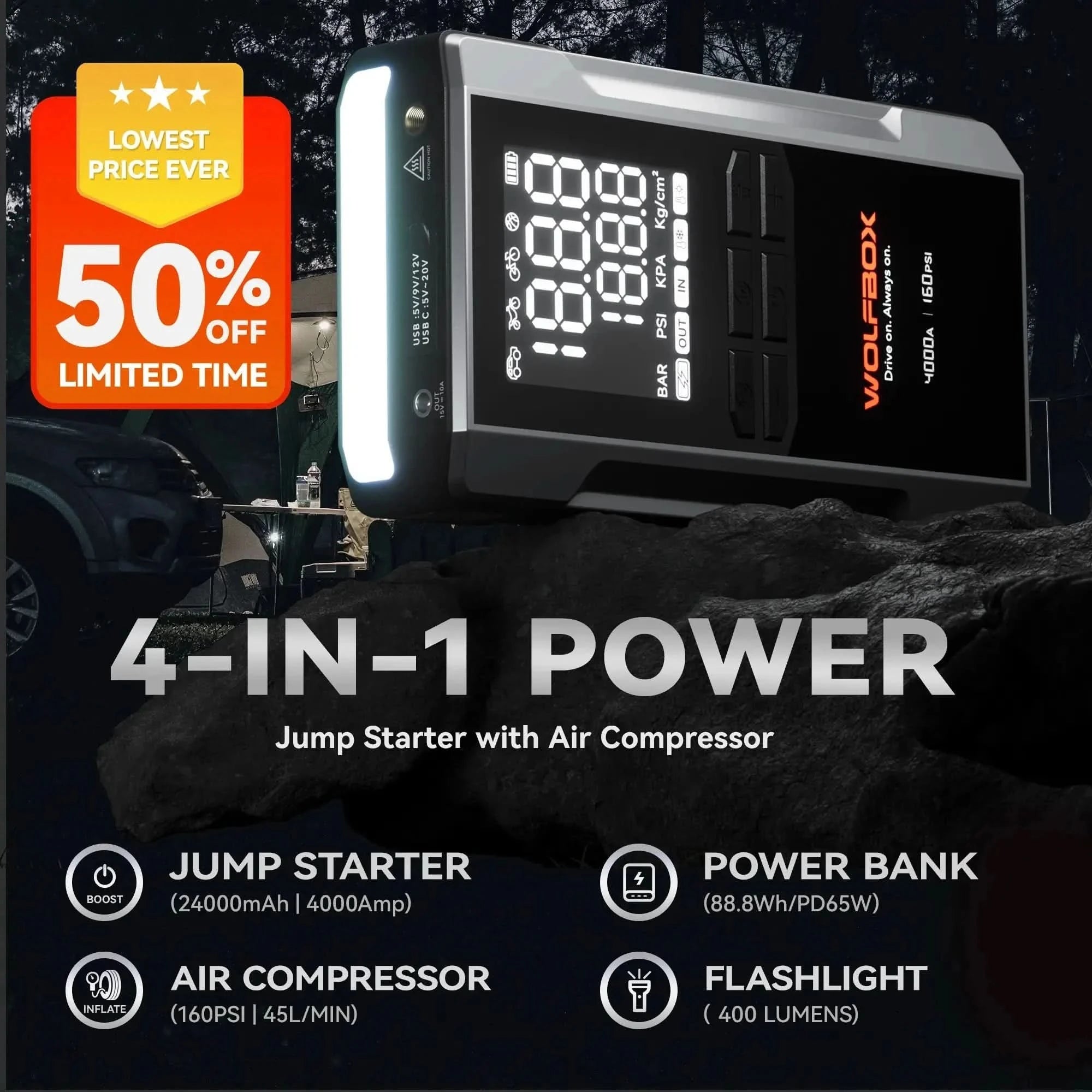
4-in-1 Jump Starter with Air Compressor | Exclusive 42-Month Warranty– Wolfbox MegaVolt 24Air
gearnudge.com
- Best for
- A versatile 4-in-1 option for emergencies.
- Avoid if
- You need confirmed live price or guaranteed fit from this page.
- Evidence
- Listing and source evidence
Compatibility checks before you buy
Before you plug anything in, you must check the battery’s chemistry.
Using a lead-acid or AGM charger on a LiFePO4 (lithium) battery can damage the battery’s management system (BMS). Look for lithium-safe options like the NOCO Genius 1 or Battery Tender 2A Selectable.
If you have an AGM (Absorbed Glass Mat) or gel battery — common in newer cars, motorcycles, and start-stop vehicles — you must use a maintainer specifically labeled as AGM/Gel-compatible. These batteries are very sensitive to overcharging and can be permanently ruined by the wrong charging profile.
Pro-tips for modern cars:
- Avoid error codes: On vehicles with battery monitoring systems, connect the negative lead to a chassis ground point (like a heavy frame bolt or engine block) instead of the battery terminal.
- Inaccessible terminals: If you can’t reach the battery, you can sometimes connect the positive lead to the fuse-panel feed point.
- Extension cords: Only use them if absolutely necessary. If you do, use 18 AWG wire for up to 50 feet, and 16 AWG for 100–150 feet.
Setup and use notes
Follow this specific order to prevent sparks or damage to your vehicle’s electronics.
For Jump Starters:
- Ensure the device is powered OFF.
- Connect the red (positive) clamp to the battery positive terminal.
- Connect the black (negative) clamp to an unpainted metal surface or engine-block bolt away from the battery and fuel lines.
- Power the unit ON.
For Motorcycles: If the battery is under a seat or side cover, clamp the actual battery terminals or a factory-documented remote jump post. Never clamp onto random frame bolts or cover screws.
What to do if it won’t start: If your battery is totally dead (0V), the jump starter’s safety computer might think there is no connection and refuse to send power. Use the “boost” or “manual-override” button to force the connection. Smart chargers may also require a “force mode” to begin recovery on a deeply discharged battery.
Avoid-if and common pitfalls
Avoid these mistakes to protect your battery and your wallet.
- Don’t use a jump starter to charge: It is high-power but low-energy. It will not provide a significant charge to a drained battery.
- Don’t expect a maintainer to revive a dead battery: It only tops up a healthy one.
- Don’t rely on your alternator to recharge a dead battery: This puts too much stress on the alternator and reduces its lifespan.
- Don’t repeat jump-starts on a drained battery: Doing this repeatedly will kill the battery. Use a plug-in charger instead.
- Note on Lithium Jump Packs: These have a limited lifespan of about one to two years. They degrade quickly if stored fully charged.
- Watch for parasitic drain: If your battery keeps dying every few days, you likely have a parasitic drain (something pulling power while the car is off). A jump pack is just a band-aid, and a maintainer won’t help if you don’t have an outlet.
FAQ
Can a jump starter charge a battery?
No. It delivers short, high-power bursts to start the engine, but it doesn't contain enough energy to recharge the battery.
Can a maintainer bring back a dead battery?
No. A maintainer is for topping up and holding a healthy battery. You need a real charger for a completely dead battery.
How long does a maintainer take?
A full recharge cycle takes roughly 8–12 hours.
Why does my battery keep dying in days?
It is almost always a parasitic drain or another vehicle problem, not a fault in your jump starter or maintainer.