Who this is for
A passenger claims you braked hard and “injured” them. Or disputes what was said inside the car. You need a clean record of both the cabin and the road, so clear video and good audio matter as much as anything else when you have to settle a dispute.
The short answer: get a three-channel dash cam with a decent interior lens. The Vantrue N4 Pro is the most-cited option for rideshare drivers. The Viofo A329 is the daytime video quality winner, and its fisheye interior lens is highly praised by Uber and taxi drivers.
That said, this is a tool with real-world limits. A veteran UberXL driver with 4,000 trips said passengers have been “chill” since he added a dash cam. He also complained that the camera gets extremely hot, reports SD card errors, and sometimes needs a reboot to work again.
Another driver found the interior footage barely usable outside bright daylight, and disabled the interior camera after two weeks over passenger-consent worries.
If you drive often enough, treat a dash cam as a required tool of the trade. Which one you buy depends on how much interior quality you actually need.
Why cabin cameras often fail you
Cabin cameras are not perfect, and there is often a big gap between what the marketing says and what the footage actually looks like.
Many drivers find that interior footage is barely usable unless it is bright daylight. Some testers have even reported that the constant worry about passenger consent made them feel more stressed than protected, leading them to disable the interior camera entirely.
You will also notice a massive difference in quality between the lenses. While the front camera might record in crisp 4K, the cabin channels are almost always lower resolution, like 1080p. Some reviewers have dismissed these lower-resolution cabin cameras as almost unusable for serious evidence.
Three groups to compare
Rideshare dash cams generally fall into three distinct groups based on how many angles they cover and how much they cost.
- Budget dual-channel setups: These record the road and the cabin but usually lack a dedicated rear camera.
- Mid-range three-channel setups: These cover the front, the cabin, and the rear of the vehicle.
- Premium multi-channel setups: These offer higher resolutions, more lenses (like 360° views), and advanced sensors for maximum protection.
Top picks with prices & key specs
Prices in this guide are vendor listings as of 2026-08-09 and can change, so confirm the current price on the seller page before you buy.
Every product listed below is frequently cited by experts for rideshare-specific protection.
Compare top picks for front, cabin, and rear recording below, then check the compatibility checklist before you buy.
Vantrue N4 Pro (~$230) This is the most-cited three-channel camera for rideshare drivers. It features a 4K front channel, wide 165° IR interior coverage, and buffered parking mode to cover the road, rear, and cabin all at once.
Viofo A329 This is the daytime video quality winner. In head-to-head testing it produced the cleanest image with the least amount of artificial sharpening, making it excellent for capturing license plates. It is also available in an A329S variant with a wide fisheye interior lens that is highly praised by taxi and Uber drivers.
Viofo A229 Pro A high-end three-channel configuration. It uses a 4K Sony Starvis 2 sensor for the front, a 2K Sony Starvis 2 sensor for the rear, and a 1080p Sony Starvis sensor for the interior, all with HDR support.
AZDOME M550 Max ($161) This camera records 4K front, 2.5K rear, and 1080P cabin footage simultaneously. It has a 150° field of view per lens, uses a supercapacitor rated to handle temperatures from -14°F to 158°F, and comes with a 64GB card. Parking mode requires a hardwire kit (sold separately).
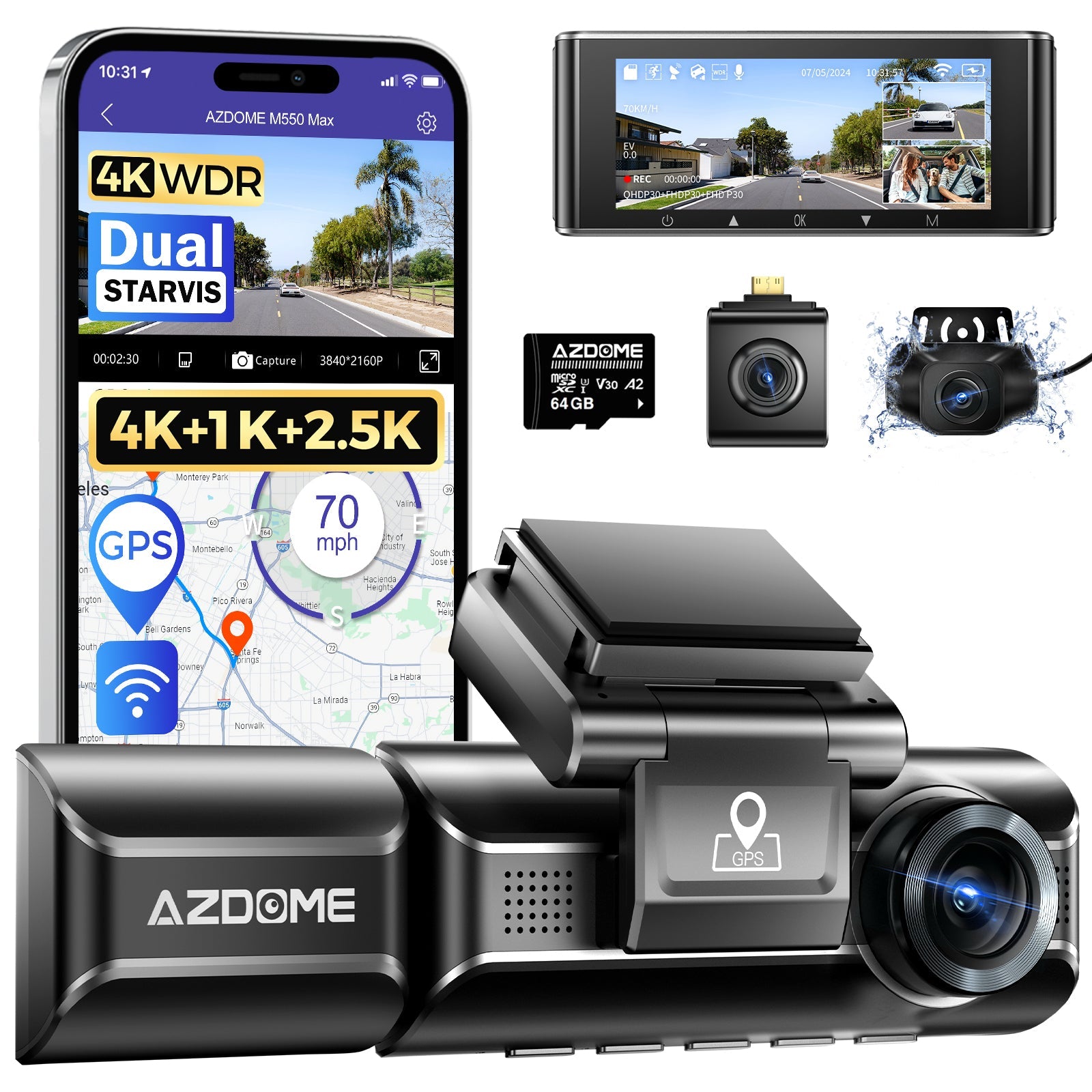
AZDOME M550 Max 3-Channel 4K Dash Cam | Front, Cabin & Rear Night Vision
gearnudge.com
- Best for
- A reliable 3-channel option with 4K front recording.
- Avoid if
- You need confirmed live price or guaranteed fit from this page.
- Evidence
- Listing and source evidence
AZDOME M550 Pro (~$109.99 sale) A more affordable two-channel setup featuring 4K front and 1080P cabin recording. It includes six 940nm IR LEDs for night vision in the cabin and comes with a 64GB card.
REDTIGER VisionPano 40 (~$259.99 sale) If you want total coverage, this four-channel system offers a 360° view. It uses dual Sony Starvis 2 sensors to record 2.5K front and rear views, plus two 1080P cabin lenses.
COOAU Dual A budget-friendly two-channel option. It provides 2.5K front and 1080P cabin recording with GPS and Wi-Fi, making it a practical choice if you don’t need a full three-channel system.
Hardwiring, parking mode & cable routing
To use parking mode—the feature that lets your camera record while the car is off—you cannot just use the cigarette lighter. You need to hardwire it.
A standard three-wire hardwire kit uses these colors:
- RED: ACC (switched power that is only on when the engine runs).
- BLACK: Ground (this must be screwed into the bare metal of the car body).
- YELLOW: B+ (constant battery power). You only need this third wire if you want parking mode to work while the car is parked.
When installing, mount the dash cam near the rearview mirror on the windshield. This location gives you the best view without obstructing the driver’s sight. Use a plastic pry tool to tuck the power cable into the gaps between the trim and the headliner. A DIY install takes about 30 minutes if you have the right kit, while professional installation typically costs between $50 and $200.
A note on fuses: You must match your hardwire kit to your car’s fuse type, such as Mini, Micro2, Low-profile Mini, or ATO. Use an “add-a-fuse” tap, putting the original car fuse in the bottom slot and a 5A dash cam fuse in the top slot.
Be careful with parking mode instructions. Some guides say hardwiring won’t drain your battery because it only draws power when the ignition is on, while others say you must connect the third wire to a constant-power fuse specifically to enable parking mode. Always check your specific kit’s manual.
What to avoid
Avoid buying cheap, “Uber-approved” systems that turn out to be nothing more than glorified toys. Some drivers have found that these systems produce footage so grainy it is useless for even a simple parking ticket dispute.
Stay away from units that have known reliability issues with heat. Some drivers have reported cameras getting extremely hot and failing when temperatures rise, which leads to SD card errors that require a manual reboot to fix.
Finally, don’t assume a 4K front camera solves everything. If the cabin channel is low-quality and lags behind, a premium front sensor won’t help you if you need to prove what happened inside the passenger compartment.
Pre-purchase compatibility checklist
Before you hit “buy,” run through these four checks to avoid the hassle of returns.
- Check your fuses: Confirm your car’s fuse type (Mini, Low-profile Mini, Micro2, or ATO) so you can match the hardwire kit’s fuse adapter; a 5A fuse is the most common size for dash cams.
- Plan your power: A hardwire kit uses three wires — ACC (switched), ground, and B+ (constant). The B+ wire is only needed if you want parking mode when the car is off. Note that sources disagree on whether a constant fuse is required for parking mode.
- Verify storage limits: Maximum microSD capacity varies by model. The AZDOME M550 Max supports up to 256GB; the REDTIGER VisionPano 40 supports up to 512GB.
- Budget for accessories: Some models require a separate hardwire kit purchase (e.g., the AZDOME M550 Max kit is sold separately). Check what’s included before you buy.
FAQ
Is cabin footage good enough at night?
Often not. Drivers report interior footage is barely usable outside bright daylight, and cabin channels are usually 1080p even when the front channel records 4K.
Do I have to hardwire the camera for parking mode?
Yes. The cigarette-lighter socket is not enough. A three-wire kit uses red for ACC, black for ground on bare metal, and yellow for constant B+, and you only need the B+ wire if you want recording while parked.
How long does the install take, and what does a shop charge?
A DIY install runs about 30 minutes with the right kit. Professional installation typically costs between $50 and $200.
Which fuse do I need?
Match the kit to your car's fuse type — Mini, Micro2, low-profile Mini, or ATO. A 5A fuse is the most common size for dash cams, fitted in the top slot of an add-a-fuse tap with the original fuse below.
Will a 4K front camera cover a passenger dispute?
Not on its own. If the cabin channel is low quality, a premium front sensor will not prove what happened inside the car.